
The Thirteen Codes Covering Michigan
Thirteen area codes serve Michigan. Eleven of them hold their own patch of ground. The other two, 947 and 679, sit on top of a neighbor and share the same territory. There is no single primary code for the state, which is the main way Michigan differs from places built around one metro area. Detroit, Grand Rapids, Lansing, and Marquette each anchor a code of their own.
Three codes date to 1947 and the first numbering plan: 313, 517, and 616. Everything else was carved out of those three as demand for lines grew. The oldest split is 906 in 1961 and the newest addition is 679 in 2025.
| Area Code | Coverage | Year Assigned | Overlay Status |
|---|---|---|---|
| 313 | Detroit, Hamtramck, Highland Park, Dearborn, Dearborn Heights, the Grosse Pointes, Redford Township, Allen Park, Ecorse, Inkster, Lincoln Park, River Rouge, Taylor | 1947 | Overlaid by 679 since 2025 |
| 517 | Lansing, East Lansing, Jackson, Howell, Adrian, Hillsdale, Charlotte, Coldwater | 1947 | No overlay |
| 616 | Grand Rapids, Holland, Grand Haven, Zeeland, Greenville, Ionia | 1947 | No overlay |
| 906 | The entire Upper Peninsula, including Marquette, Sault Ste. Marie, St. Ignace, Escanaba, Iron Mountain, Munising, Mackinac Island | 1961 | No overlay |
| 810 | Flint, Port Huron, Lapeer, Brighton, the Thumb and the southern Flint belt | 1993 | No overlay |
| 248 | Oakland County and the northern Detroit suburbs, plus Northville and Livonia edges | 1997 | Overlaid by 947 since 2002 |
| 734 | Ann Arbor, Ypsilanti, Monroe, western Wayne County, downriver communities | 1997 | No overlay |
| 231 | Traverse City, Muskegon, Ludington, Petoskey, Big Rapids, Cheboygan | 1999 | No overlay |
| 586 | Macomb County: Warren, Sterling Heights, Clinton Township, Mount Clemens, St. Clair Shores | 2001 | No overlay |
| 989 | Saginaw, Bay City, Midland, Mount Pleasant, Owosso, Alpena, Gaylord, Bad Axe, Tawas City | 2001 | No overlay |
| 269 | Kalamazoo, Battle Creek, Benton Harbor, St. Joseph, Allegan, Hastings | 2002 | No overlay |
| 947 | The same Oakland County ground as 248 | 2002 | Overlay of 248 |
| 679 | The same Detroit and close Wayne County ground as 313 | 2025 | Overlay of 313 |
Reading the Michigan Area Code Map
The easiest way to read the map is by region rather than by number. Southeast Michigan holds five separate codes plus an overlay pair, because that is where the population and the phone lines are thickest. West Michigan holds three. The middle of the state and the north each get one large code, and the Upper Peninsula gets one code for the whole thing.
- Detroit and close Wayne County - 313 and its 679 overlay
- Oakland County and the north suburbs - 248 and its 947 overlay
- Macomb County - 586
- Ann Arbor, Ypsilanti, Monroe, western Wayne, downriver - 734
- Flint, Port Huron, Lapeer, Brighton, the Thumb - 810
- Grand Rapids and Holland, plus Kalamazoo and Traverse City to the south and north - 616, 269, and 231
- Lansing and Jackson, then Saginaw and the north, then the Upper Peninsula - 517, 989, and 906
A few edges do not follow county lines. The 248 territory reaches into a slice of Wayne County near Northville, and the 313 footprint shrank twice, first when 810 was created and again when 734 took the western and downriver suburbs. Rate center boundaries, not city limits, decide those edges.
Michigan's Newest Area Code
The 679 code is the newest thing on the Michigan map, and it exists because 313 was running out of numbers. NANPA petitioned the Michigan Public Service Commission for relief, and the commission held a public hearing in January 2023 to weigh the options. Its notice spelled out the territory involved: Detroit, Hamtramck, Highland Park, Allen Park, Dearborn, Dearborn Heights, Ecorse, the Grosse Pointes, Inkster, Lincoln Park, Redford Township, River Rouge, and Taylor.
The MPSC hearing notice laid out the exhaust forecast and the overlay proposal before any date was locked in.
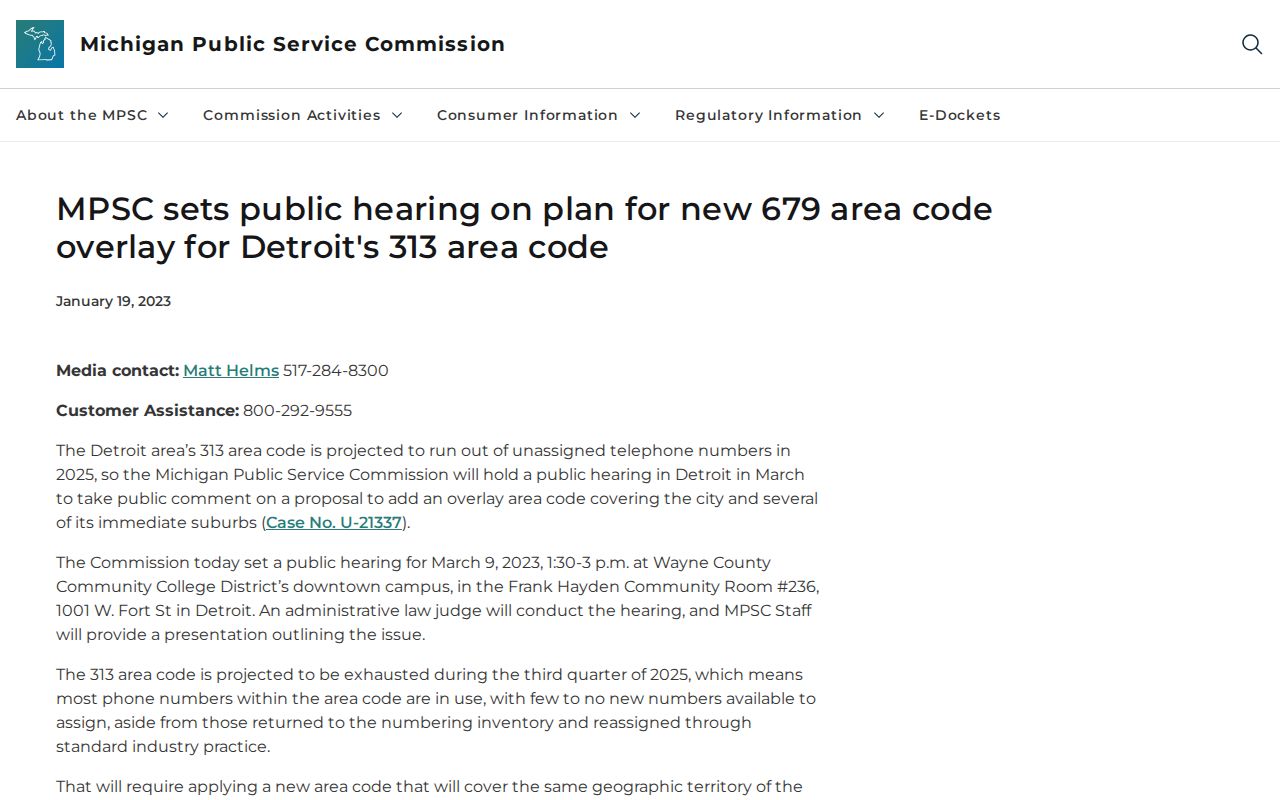
Commission approval matters here because the Michigan Telecommunications Act gives the MPSC the power to accept or reject an area code change in this state.
The choice of an overlay over a split was deliberate. In Detroit, 313 is more than routing. It shows up in music, on merchandise, and in how people describe where they are from. A geographic split would have forced part of the city onto a new code. An overlay leaves every existing number alone and simply adds a second code to the same streets. New lines draw 679 only after the 313 supply runs dry, which the commission projected for the first quarter of 2028.
The March 2025 announcement set the full schedule for the rollout.
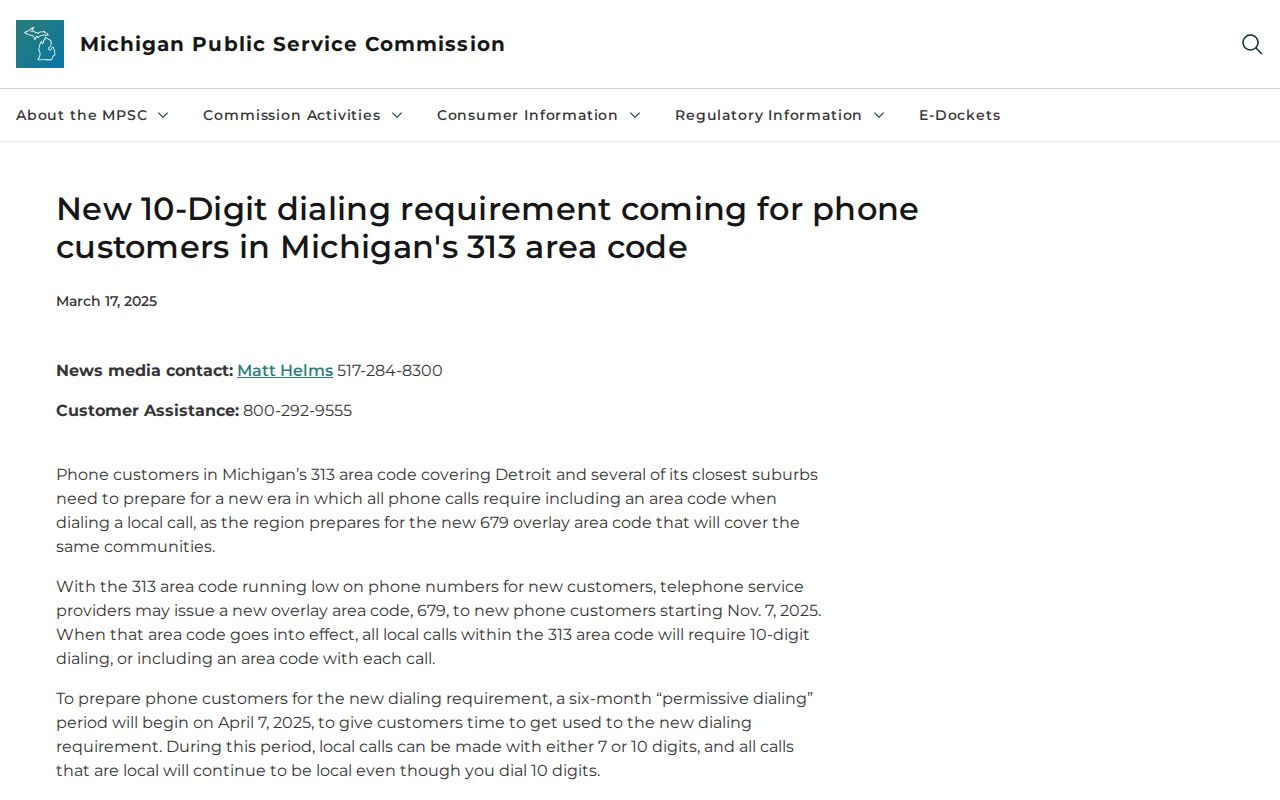
Permissive dialing opened April 7, 2025, giving customers six months to break the seven-digit habit before it stopped working.
Michigan Area Code Overlays and Splits
Michigan has used both methods, so the difference is easy to see here. Nine of the state's codes came from splits, where a chunk of territory was carved off and handed a new number. Two came from overlays, where a new code was laid over ground that already had one. Splits change who you are. Overlays change how you dial.
- Overlay
- A second area code added to the same geography. Everyone keeps their existing number, and ten-digit dialing becomes mandatory. Michigan examples are 947 over 248 and 679 over 313.
- Split
- The old code keeps part of the map and the new code takes the rest. People in the new region get a new area code. Michigan examples are 810 and 734 from 313, 989 from 517, and 906, 231, and 269 from 616.
- Permissive Dialing
- The window when both the old and new dialing patterns connect. It ends on a fixed date, after which only the new pattern works.
Michigan Dialing Rules by Area Code
Michigan does not have one dialing rule. Overlay territory requires all ten digits, because two codes share the same streets and seven digits would be ambiguous. Parts of the state where 988 existed as a local exchange prefix also moved to ten digits under the federal crisis line change. Some non-overlay areas still let a seven-digit local call through, depending on the carrier and the rate center.
Important: Local calls inside the 313 and 679 area have required ten digits since October 7, 2025. Seven-digit calls there no longer connect.
The MPSC reminder from September 2025 gave customers three weeks of notice before the cutover.
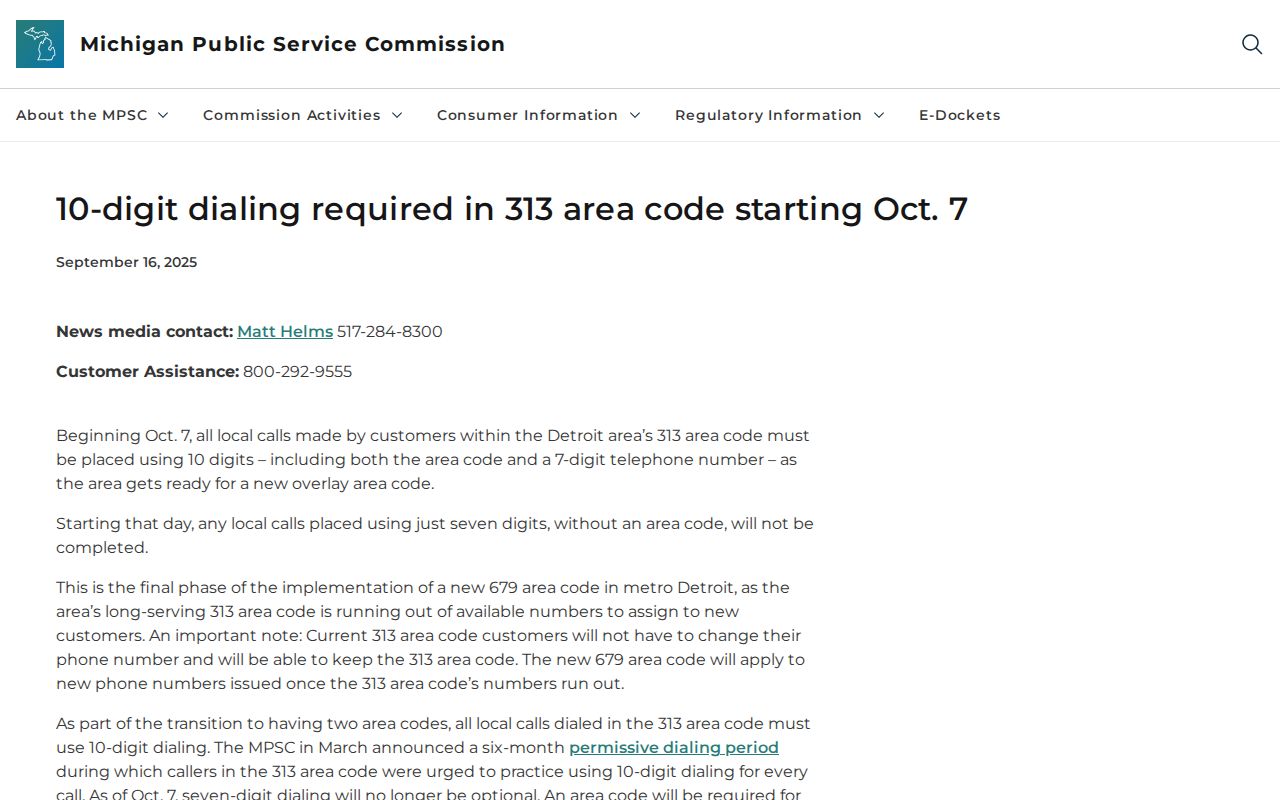
The commission also warned that equipment which dials on its own needed reprogramming, including alarm panels, medical alert devices, fax machines, and auto-dialers. Long distance still takes a 1 in front of the ten digits on most landlines. The rest of the dialing picture, meaning the N11 codes, the star codes, and the toll-free prefixes, sits on the Michigan phone codes page.
Michigan Area Codes Since 1947
Michigan started with three codes and ended up with thirteen. The 1947 assignment gave Detroit and the southeast 313, the center of the state 517, and the west side plus the Upper Peninsula 616. Michigan Bell ran most of the wire, later becoming Ameritech, then SBC, then AT&T Michigan, while small independent companies served rural exchanges. That three-code map held for fourteen years.
Then the splits came, first slowly and then in a rush. The Upper Peninsula left 616 in 1961. Nothing changed again until 1993, when fax machines, pagers, dial-up modems, and early cell phones started eating numbers faster than anyone had planned for. Between 1993 and 2002, Michigan added seven new codes.
| Year | Event |
|---|---|
| 1947 | Michigan receives 313, 517, and 616 in the original numbering plan |
| 1961 | 906 splits from 616 for the Upper Peninsula |
| 1993 | 810 splits from 313 for Flint, the Thumb, and outer southeast Michigan |
| 1997 | 248 splits from 810 for Oakland County |
| 1997 | 734 splits from 313 for Ann Arbor, Monroe, western Wayne, and downriver |
| 1999 | 231 splits from 616 for northwest Lower Michigan |
| 2001 | 586 splits from 810 for Macomb County |
| 2001 | 989 splits from 517 for central and northeast Lower Michigan |
| 2002 | 269 splits from 616 for southwest Michigan |
| 2002 | 947 arrives as Michigan's first overlay, covering 248 |
| 2025 | 679 overlays 313; mandatory ten-digit dialing starts October 7 |
Note: several Michigan codes once covered far more ground than they do now, so an old letterhead may show a number that has since changed codes twice.
Prefixes Inside Michigan Area Codes
The three digits after a Michigan area code are the exchange prefix, written as NXX. Historically each prefix tied to a central office building and a rate center, which is the billing area a phone line belongs to. Grand Rapids, Holland, and Zeeland are separate rate centers inside 616. Marquette, Sault Ste. Marie, and Escanaba are separate rate centers inside 906, even though one code covers the whole peninsula.
NANPA publishes the assignment records, sorted by state and then by area code and prefix, and those files are the authoritative answer for who was originally handed a block. What they cannot tell you is who serves the number today. Portability lets a line keep its digits while moving to a different company, so a 313 prefix that started as a Detroit landline may be a mobile or internet line now. The Michigan phone codes page goes deeper on how prefixes work.
Future Area Codes for Michigan
The 679 overlay finished on November 7, 2025, and the commission's 2025 annual report treats that as the close of Michigan's current relief work. New 679 numbers are assigned only as the remaining 313 supply is used up, which the forecast puts at the first quarter of 2028. Demand can move that date in either direction.
No other Michigan code has a relief plan on the table right now. If one does come up, the process is the same as it was for Detroit. NANPA files a petition based on exhaust forecasts, the Public Service Commission holds a hearing and takes public comment, and the commission decides between an overlay and a split. For residents, an overlay means almost nothing changes: existing numbers stay put, and the only real adjustment is dialing all ten digits.
Is That Michigan Area Code Real
If a caller says a number is from a certain Michigan city, the area code is worth a quick check. NANPA is the authority on which codes exist and where they are assigned, and its site is the place to confirm that a code is real before you trust the story attached to it.
NANPA administers the numbering plan for the United States and publishes the reference material behind every area code.
Verifying that a code exists is a different question from verifying who is calling, since caller ID can be faked no matter how legitimate the code looks.
Note: a valid area code only proves the number exists, never that the person calling from it is who they claim to be.